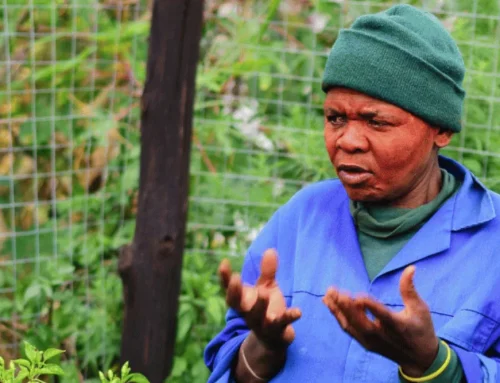
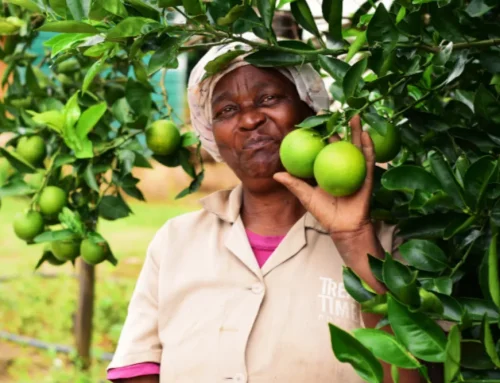
For Hellen Magongoa, farming is how she puts food on the table, supports her family, and builds a more secure future. Based in Bela-Bela, she has spent the past three years growing vegetables such as spinach, cabbage, beetroot, carrots, onions, and green peppers. Her backyard production has provided nutritious food for her family while generating income through local sales.
Through support provided by the 11th Hour Project, a community-driven agroecology initiative coordinated by Seriti Institute, Hellen received a rainwater harvesting tank that helped improve water conservation and reduce household water costs.
In late 2025, prolonged heavy rains across the Waterberg region brought unexpected challenges. Surface runoff washed away crops, newly planted seedlings, and nutrient-rich topsoil, threatening both her productivity and household food security.
“The heavy rains damaged much of what I had planted, but I knew I had to find a way forward,” says Hellen. “Through the training and learning from other farmers, I understood that I needed to adapt.”
Drawing on knowledge gained through climate change and agroecology training and farmer learning exchanges, Hellen introduced deep-rooted crops such as butternut and beans while awaiting soil test results. These crops helped stabilize the soil, reduce erosion, and access nutrients from deeper soil layers. Broad-leaved and runner crops also protected the soil surface from further runoff and nutrient loss.
Although the season yielded lower returns than her usual vegetable production, Hellen was able to continue producing food and generating income while her land recovered. Through the sale of butternut and its leaves, which were also consumed at home as nutritious morogo, she generated between R1,000 and R1,500 during the season, providing an important source of income for her household.
Today, Hellen continues to apply the knowledge gained through agroecology training and farmer learning exchanges. Her journey shows that with the right support, practical knowledge, and willingness to adapt, smallholder farmers can protect their livelihoods and build resilience in the face of a changing climate. By combining traditional practices with agroecological approaches, Hellen is not only restoring her soil but also building a more sustainable future for her family and community.